Bakuchi Benefits for Hair and Scalp Care: Traditional Use and Safety Guide. Bakuchi is a traditional botanical ingredient found in selected Ayurvedic preparations, but discussions of Bakuchi benefits for hair require care. The herb—also commonly called Babchi—is not an everyday kitchen ingredient that should be applied raw or in arbitrary concentrations. Its traditional reputation must be balanced with formulation quality, individual suitability and sensible precautions.
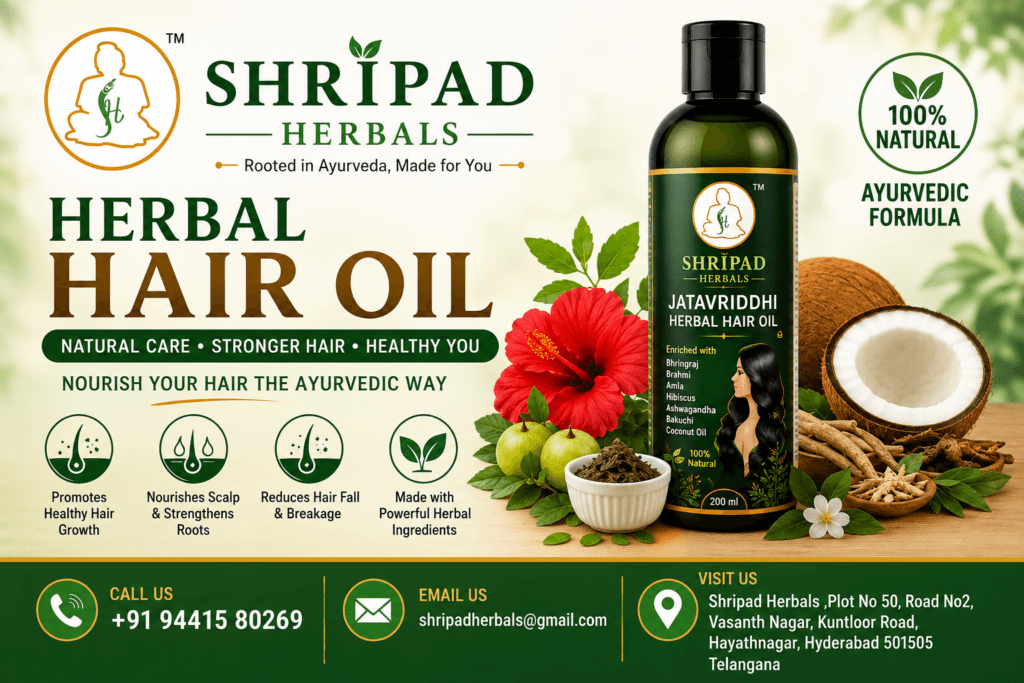
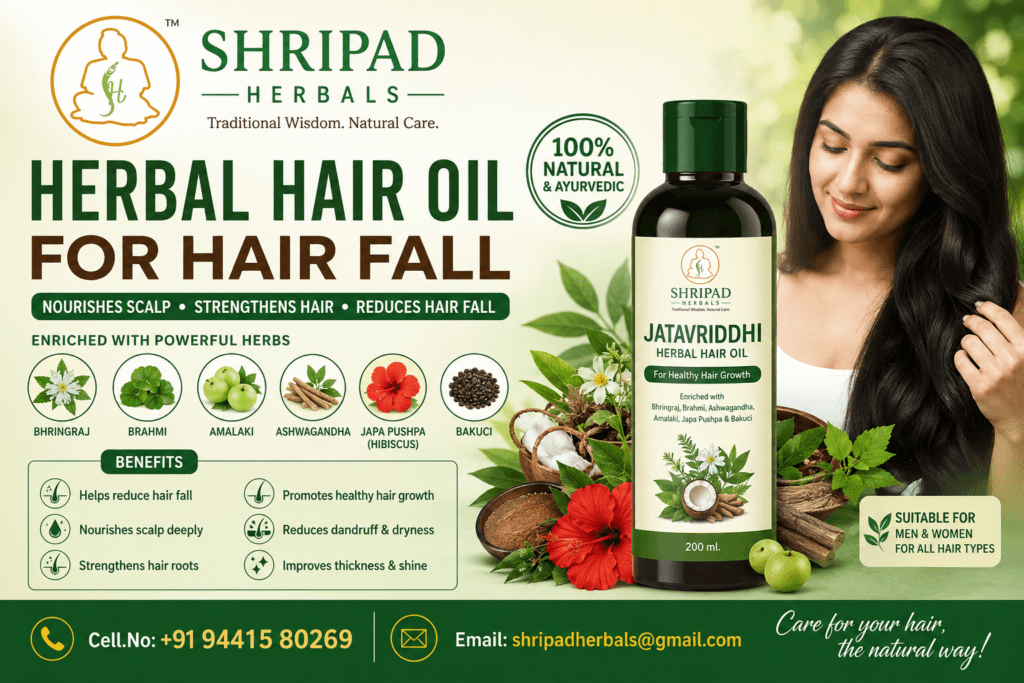
In Jatavriddhi Herbal Hair Oil, Bakuchi is included as one part of a multi-herbal formula with Coconut Oil, Bhringraj, Brahmi, Ashwagandha, Amalaki and Japa Pushpa. The finished oil is intended to support a regular scalp-massage and hair-conditioning routine; it should not be portrayed as a guaranteed cure for hair loss, baldness or premature greying.
This guide explains Bakuchi’s role in traditional hair care, how it differs from the other Jatavriddhi ingredients, why homemade concentrated preparations are unwise and how to use a finished herbal oil responsibly.
What Is Bakuchi?
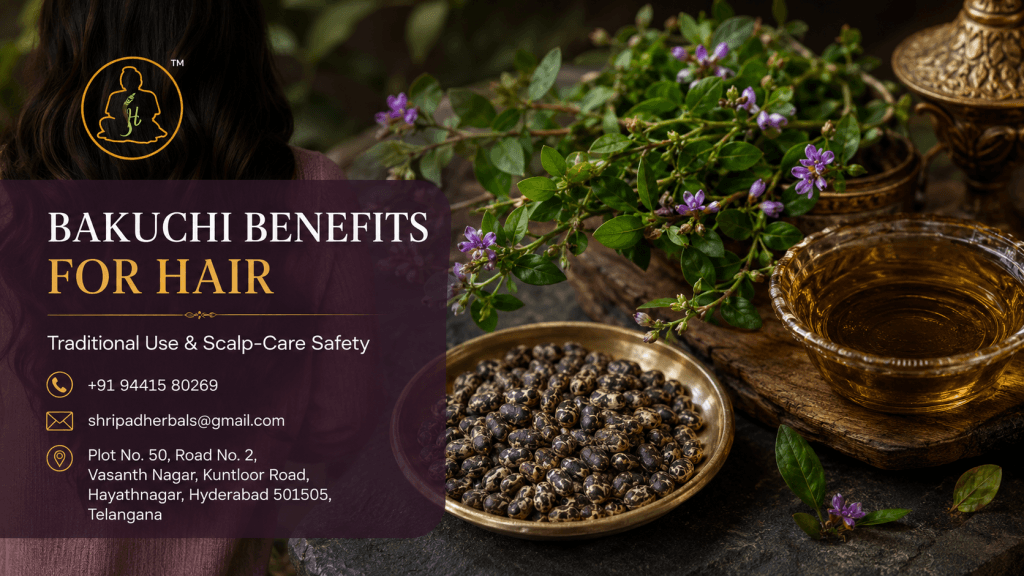
Bakuchi Benefits for Hair, Bakuchi is the Ayurvedic name commonly associated with Psoralea corylifolia, also referred to in botanical literature as Cullen corylifolium. It is also known as Babchi in parts of India. The seeds have a history of use in traditional preparations, including specialised skin applications.
That traditional background does not mean raw Bakuchi seed powder or extract is automatically safe for the scalp. The plant is associated with naturally occurring psoralen compounds, which can interact with ultraviolet light. The concentration, extraction method, carrier and directions of the finished formulation therefore matter.
Consumers should use an appropriately manufactured product according to its label rather than preparing an unmeasured Bakuchi mixture at home.
What Are the Traditional Bakuchi Benefits for Hair?
Bakuchi’s responsible role in hair care is best understood within a complete botanical formulation.
1. Contributes to a Multi-Herbal Ayurvedic Formula – Bakuchi Benefits for Hair
Bakuchi adds to the traditional botanical profile of Jatavriddhi Hair Oil. Instead of relying on one fashionable ingredient, the formulation combines several herbs with a Coconut Oil carrier.
This multi-herbal approach is central to the product’s identity. It does not mean that every individual ingredient independently delivers every claimed outcome.
2. Complements Scalp Massage
A measured amount of herbal oil can be distributed across the scalp with the fingertips. Gentle massage can make oil application more even and create a deliberate self-care routine.
The physical massage should remain gentle. Forceful rubbing, scratching or pulling the hair does not increase the benefit of Bakuchi and may irritate the scalp or break fragile strands.
3. Supports a Hair-Conditioning Routine
The Coconut Oil base helps lubricate the hair and may improve softness and manageability. Bakuchi forms part of the botanical blend carried within that oil.
Better lubrication can reduce friction during handling, which may help limit some dryness-related breakage. This is a realistic cosmetic benefit and should not be confused with treating follicular hair loss.
4. Broadens the Traditional Ingredient Blend
Jatavriddhi combines Bakuchi with better-known hair-care herbs such as Bhringraj, Amla, Brahmi and Hibiscus. Each ingredient contributes to the formulation’s traditional positioning, while the finished product—not a single isolated herb—is what the consumer applies.
Is Bakuchi Proven to Grow Hair?
There is insufficient reliable human evidence to promise that a topical cosmetic oil containing Bakuchi will regrow hair or reverse baldness. Traditional use, laboratory findings and research on isolated compounds cannot automatically establish the performance of a finished consumer hair oil.
Hair loss can arise from hereditary factors, hormonal changes, autoimmune disease, scalp infection, nutritional deficiency, illness, medicines, ageing or damaging hair practices. A botanical oil cannot address every cause.
People with sudden bald patches, rapid shedding, progressive thinning, scalp pain, sores or persistent inflammation should consult a qualified dermatologist. A timely diagnosis is more useful than repeatedly changing cosmetic products.
Bakuchi Hair Oil and Hair Breakage
Hair breakage and hair loss are frequently confused.
- Breakage occurs when an existing strand snaps along its length.
- Shedding occurs when a strand separates from the follicle as part of a natural or altered cycle.
- Follicular hair loss can involve hereditary, inflammatory, autoimmune or other medical processes.
A suitable oil may help condition dry strands and reduce friction during combing or washing. That can support retention of existing length by limiting avoidable breakage. It does not prove that Bakuchi has created new follicular growth.
For a broader explanation, read our Herbal Hair Oil guide.
Why Bakuchi Requires Extra Safety Awareness
Bakuchi Benefits for Hair, Bakuchi deserves more cautious handling than many commonly used botanical hair ingredients because it is associated with psoralen compounds. Psoralens can make skin react abnormally when followed by exposure to ultraviolet A light.
Phototoxic reactions can involve redness, burning, blistering and later pigmentation. The risk depends on the substance, concentration, duration of contact, amount of light exposure and individual factors.
For an authoritative explanation of plant-derived photosensitivity, see DermNet’s guide to phytophotodermatitis.
This does not establish that every correctly formulated product containing Bakuchi will cause a reaction. It explains why consumers should avoid careless DIY use, follow the finished-product label, patch-test and seek advice if any reaction develops.
Why Raw Bakuchi DIY Treatments Are Not Recommended
Online recipes sometimes advise grinding seeds, preparing concentrated extracts or combining herbs without measured quantities. Such recipes create avoidable uncertainty:
- The botanical identity may be incorrect.
- The ingredient strength may vary between batches.
- The concentration is not standardised.
- Contamination may occur during preparation or storage.
- The carrier may not distribute the ingredient safely.
- Sunlight precautions may be ignored.
- The mixture may irritate an already sensitive scalp.
- Users may continue despite burning because they believe discomfort indicates effectiveness.
A commercially prepared finished formulation provides declared ingredients, usage directions and traceability that an improvised mixture lacks. Consumers should still verify the label and use the product only as directed. Bakuchi Benefits for Hair are as below
Bakuchi Compared With Other Jatavriddhi Ingredients
| Ingredient | Traditional role in the formulation | Practical consumer perspective |
|---|---|---|
| Bakuchi | Specialised Ayurvedic botanical ingredient | Requires particular attention to label directions, patch testing and photosensitivity precautions |
| Bhringraj | Strongly associated with traditional Indian hair oils | Supports the multi-herbal scalp-oiling identity |
| Amla | Common in traditional oils, powders and shampoos | Complements botanical conditioning and hair-care routines |
| Brahmi | Used in traditional scalp and hair preparations | Adds to the Ayurvedic botanical blend |
| Ashwagandha | Included in a range of traditional formulations | Complements the scalp-massage and multi-herbal positioning |
| Japa Pushpa | Commonly known as Hibiscus and used in botanical hair care | Associated with traditional conditioning preparations |
| Coconut Oil | Carrier oil | Helps spread the herbs and lubricate the scalp and hair |
No ingredient should be advertised as a miracle cure. The complete formulation, manufacturing controls, suitability and correct use matter more than declaring one herb “best.”
Bakuchi Versus Bhringraj for Hair
Bhringraj is among the most recognisable herbs in traditional hair-oiling practices. Bakuchi has a more specialised traditional identity and requires greater safety awareness because of its association with psoralen compounds.
They should not be treated as interchangeable DIY powders or extracts. In Jatavriddhi, both belong to a finished multi-herbal composition. Users apply the complete oil according to its label rather than selecting an arbitrary concentration of either herb.
Internal-link placement: Link “Bhringraj benefits for hair” to the existing Bhringraj article.
Bakuchi Versus Amla for Hair
Amla is widely used across oils, shampoos and powders, whereas Bakuchi is less suitable for casual home experimentation. Both may appear within traditional formulations, but their identities and safety considerations differ.
Read the published guide to Amla benefits for hair for its individual role in the Jatavriddhi cluster.
How to Use Herbal Hair Oil Containing Bakuchi
The current product label is the primary source for application instructions. A cautious general routine includes the following.
Step 1: Read the Complete Label
Check the ingredient list, external-use statement, application directions, warnings, batch information and expiry details before first use.
Step 2: Patch-Test the Finished Oil
Apply a small amount to a limited, discreet area according to professional or label guidance. Do not proceed with broader use if redness, itching, burning, swelling or blistering develops.
Step 3: Consider Light Exposure
Because Bakuchi is associated with photosensitising compounds, follow any light-avoidance or timing instructions on the finished product. Do not assume that a preparation can be applied before strong sunlight unless its directions clearly permit it.
Step 4: Check the Scalp
Avoid applying a new oil over open wounds, active sores, unexplained rashes, infection or severe inflammation.
Step 5: Begin With a Moderate Quantity
Start with enough to distribute lightly. Excessive oil does not create faster results and can make cleansing more difficult.
Step 6: Massage Gently
Use fingertip pads without scratching. A longer or more forceful massage is not necessarily more useful.
Step 7: Follow the Contact-Time Directions
Do not leave the product on for an extended period merely because it contains herbs. Use the timing specified on the current label.
Step 8: Cleanse Carefully
Wash with a suitable shampoo as directed. Avoid vigorous rubbing or very hot water, particularly if the scalp is sensitive.
Step 9: Observe the Scalp Afterwards
Stop using the product and obtain appropriate advice if discomfort, unusual redness, blisters, swelling or persistent pigmentation develops.
Who Should Seek Advice Before Use?
Extra caution is appropriate for people who:
- Have a history of photosensitivity.
- Have reacted to herbal products or hair dyes.
- Have eczema, psoriasis or another diagnosed scalp condition.
- Are using prescription scalp medication.
- Have broken or infected scalp skin.
- Are receiving phototherapy or using medicines that increase light sensitivity.
- Have recently experienced an unexplained rash after sun exposure.
- Are pregnant, breastfeeding or selecting products for a child and need individual professional guidance.
This article provides general educational information and does not replace personalised medical advice.
Common Mistakes With Bakuchi Hair Preparations
Assuming Natural Means Risk-Free
Plants contain biologically active compounds. Natural origin does not remove the possibility of irritation, allergy or phototoxicity.
Applying Raw Seed Paste to the Scalp
An unmeasured paste does not provide control over identity, concentration, purity or exposure.
Going Into Strong Sunlight Without Checking Directions
Photosensitising compounds can interact with ultraviolet light. The product label and professional guidance should take priority over online routines.
Ignoring Burning or Redness
Discomfort is not proof of effectiveness. Remove the product and stop use if a reaction develops.
Expecting a Cure for Baldness
Bakuchi-containing hair oil should not delay assessment of sudden, patchy or progressive hair loss.
Using More Than Directed
Higher quantities and longer contact do not guarantee better cosmetic results and may increase exposure.
How Often Can Bakuchi Hair Oil Be Used?
There is no universal frequency suitable for every finished formulation or scalp. Follow the current Jatavriddhi label. The appropriate routine can depend on:
- Product directions and concentration.
- Individual scalp sensitivity.
- Hair texture and density.
- Washing frequency.
- Environmental and sun exposure.
- Use of other scalp products.
- Advice from a qualified professional where relevant.
Do not increase frequency merely to accelerate results. Consistency within the recommended directions is safer than excessive application.
Choosing a Herbal Hair Oil With Bakuchi
Before purchasing, check:
- The complete ingredient declaration.
- Manufacturer and contact information.
- Batch number and expiry details.
- External-use and application directions.
- Relevant cautions on the label.
- Packaging condition and seal.
- Current price, quantity and return policy.
- Whether claims are realistic rather than guaranteed.
Avoid products that promise instant regrowth, guaranteed reversal of greying or treatment of every scalp condition.
Bakuchi Hair Oil in Hyderabad
Shripad Herbals is based in Hayathnagar, Hyderabad, Telangana. Its Jatavriddhi Herbal Hair Oil uses Coconut Oil as a carrier and combines Bakuchi with Bhringraj, Brahmi, Ashwagandha, Amla and Hibiscus.
The formulation is relevant to customers searching for a multi-herbal Ayurvedic hair oil in Hyderabad and across India. Before ordering, consumers should confirm the current label, ingredients, quantity, price, availability and delivery details directly with Shripad Herbals.
Why Bakuchi Is Included in Jatavriddhi
Bakuchi Benefits for Hair, Bakuchi does not stand alone in Jatavriddhi. It contributes to a broader botanical composition designed for a traditional scalp-massage and hair-conditioning routine.
The formulation approach offers several practical advantages:
- Multiple traditional botanicals are provided in one finished oil.
- Coconut Oil serves as the carrier.
- Users do not need to source and mix raw Bakuchi themselves.
- The product has stated directions and identifiable manufacturer information.
- The oil can be paired with a gentle cleansing routine.
These points describe the product format without guaranteeing a medical or hair-growth outcome.
When to Consult a Dermatologist
Professional assessment is advisable for:
- Sudden or rapidly increasing shedding.
- Round or irregular bald patches.
- Progressive thinning or a widening part.
- Pain, burning or intense itching of the scalp.
- Blisters or redness after using a botanical product.
- Persistent scaling, sores, discharge or swelling.
- Hair loss following illness or medication.
- Loss involving eyebrows, beard or body hair.
- Any reaction that appears or worsens following sunlight.
Stop the suspected product and seek timely advice if a significant skin reaction develops.
Frequently Asked Questions
What are the main Bakuchi benefits for hair?
Bakuchi contributes to the traditional botanical profile of a multi-herbal hair oil. The finished oil can support scalp massage and hair conditioning, but Bakuchi should not be presented as a guaranteed hair-regrowth treatment.
Is Bakuchi the same as Babchi?
Bakuchi and Babchi are common names associated with Psoralea corylifolia, also classified as Cullen corylifolium. Consumers should verify the ingredient declaration on the finished product.
Can Bakuchi oil regrow hair?
There is insufficient reliable human evidence to guarantee hair regrowth from a cosmetic Bakuchi oil. Different forms of hair loss require accurate diagnosis and appropriate management.
Can I apply raw Bakuchi powder to my scalp?
Unmeasured DIY preparations are not recommended. Botanical identity, concentration, purity, stability and photosensitivity precautions may be uncertain.
Can Bakuchi react with sunlight?
Bakuchi is associated with psoralen compounds, and psoralens can produce phototoxic reactions when skin exposure is followed by ultraviolet A light. Follow the finished-product directions and obtain professional advice when needed.
Should I patch-test a hair oil containing Bakuchi?
Yes. Patch-test the finished product according to appropriate guidance, and stop use if redness, itching, burning, swelling or blistering occurs.
Which herbs are combined with Bakuchi in Jatavriddhi Hair Oil?
Jatavriddhi combines Bakuchi with Coconut Oil, Bhringraj, Brahmi, Ashwagandha, Amalaki and Japa Pushpa. Verify the current label before publishing or purchasing.
Where can I buy herbal hair oil with Bakuchi in Hyderabad?
Shripad Herbals in Hayathnagar, Hyderabad, offers Jatavriddhi Herbal Hair Oil. Contact the company to confirm current price, stock and delivery availability.
Use Traditional Botanical Hair Care Responsibly
Bakuchi is a distinctive component of Jatavriddhi Herbal Hair Oil, but responsible use matters more than exaggerated claims. Select a finished formulation, read its label, patch-test, follow application and light-exposure precautions and discontinue use if a reaction occurs.
Combine hair oiling with gentle shampooing, suitable conditioning, careful detangling and limited heat. Seek a dermatologist’s guidance for sudden, patchy, severe or persistent hair loss.
Contact Shripad Herbals
For current Jatavriddhi Herbal Hair Oil information:
- Phone: +91 94415 80269
- Email: shripadherbals@gmail.com
- Address: Shripad Herbals, Plot No. 50, Road No. 2, Vasanth Nagar, Kuntloor Road, Hayathnagar, Hyderabad 501505, Telangana
Contact Shripad Herbals to learn more about Jatavriddhi Herbal Hair Oil, its current label directions, availability and delivery. Bring a carefully prepared multi-herbal oil into your routine without relying on unsafe DIY Bakuchi mixtures or unrealistic promises.
Useful articles on Herbal Hair Oil
- Herbal hair oil
- Herbal hair oil for hair fall
- Bhringraj benefits for hair
- Amla bnefits for hair
- Brahmi benefits for hair
- Hibiscus benefits for hair
- Fenugreek benefits for hair
- Curry leaves benefits for hair
- Herbal hair oil for hair growth
- Herbal hair oil for men
- Best herbal hair oil in Hyderabad
- Herbal hair oil for dry hair